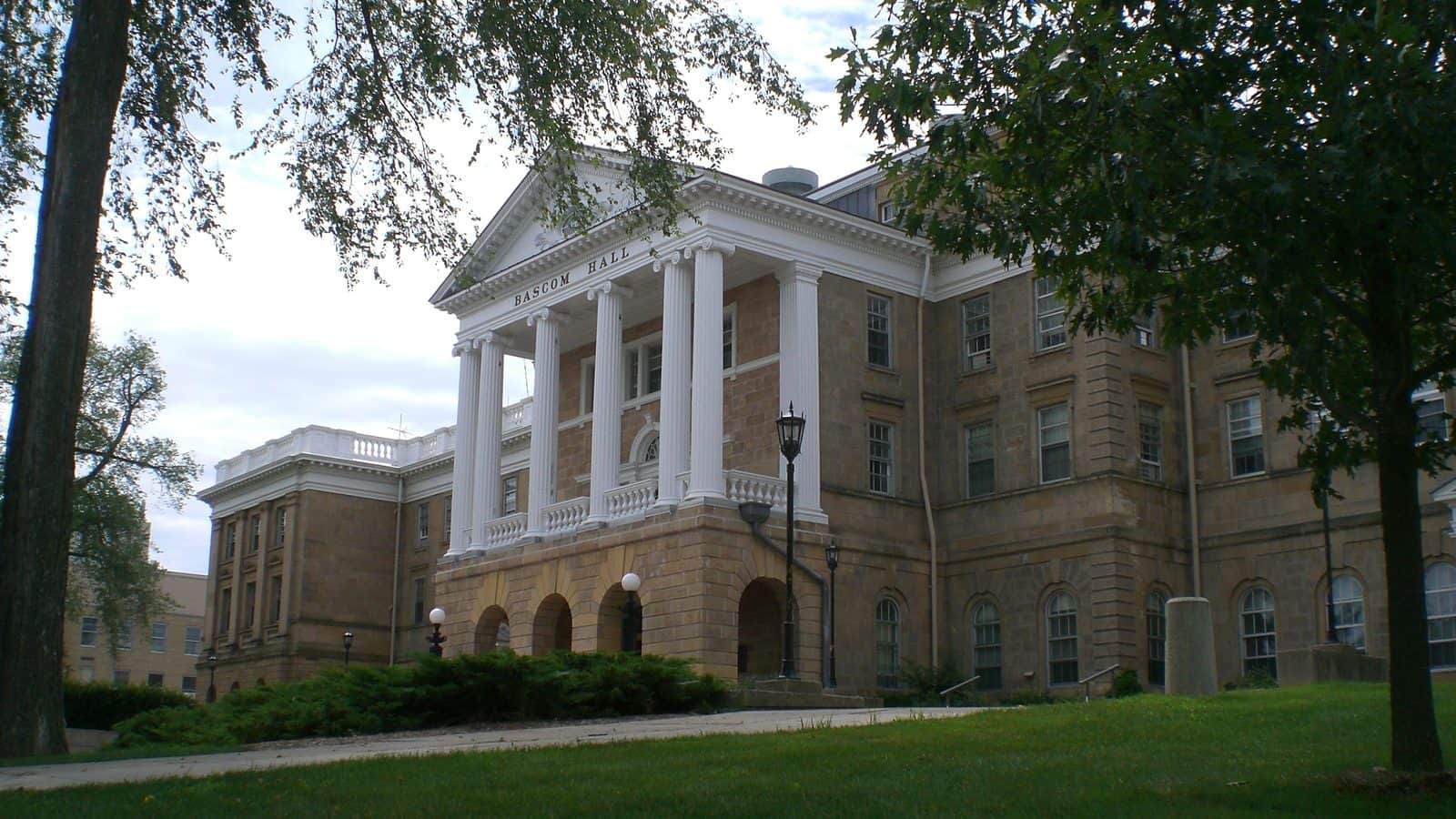
30 Essays that Worked at University of Wisconsin-Madison
Updated for the 2026-2027 admissions cycle.
Where do you stand in the admissions race?
 About University of Wisconsin-Madison
The University of Wisconsin-Madison is a leading public research university set on the shores of Lake Mendota in Wisconsin's capital city. Founded in 1848, UW-Madison is known for its strong programs across the sciences, engineering, journalism, and life sciences, and consistently ranks among the top public research universities nationally for research spending. The Wisconsin Idea - the belief that university research and teaching should directly benefit the public - shapes the school's identity, from its agricultural extension programs to its civic-minded student culture. Madison's campus, anchored by the iconic Bascom Hill and Camp Randall Stadium, gives students an inseparable mix of serious academics and passionate Badger sports culture, all set within one of the country's most livable college towns.
At a glance…
| Acceptance Rate | 45% |
| Tuition | $42,103 |
| Average Cost | $16,834 |
| Average SAT | 1430 |
| Average ACT | 31 |
| Location | Madison, WI |
Real University of Wisconsin-Madison Supplemental Essay Examples
University of Wisconsin-Madison Supplemental Essay Prompts for 2026-2027
All one prompt in full. Requirements can vary by school or program, so check your own application for exactly what you need to write.
Prompt: Tell us why you would like to attend the University of Wisconsin–Madison. In addition, please include why you are interested in studying the major(s) you have selected. If you selected undecided, please describe your areas of possible academic interest.
“Yep, it’s definitely getting darker” I tentatively dip the thermometer into the beaker and watch the bar rise.
“Bring the ice over, let’s try cooling this down.” As my partner brings over a tray filled with ice cubes, I jot down quick observations about the color of the solution.
Seconds later, the olive hue in the solution dissipates, and a lighter green replaces it. Huh. Our teacher had told us that different temperatures would affect the concentration of products and reactants, but it was up to us to interpret just how.
“Wait, we know that heating it up made the solution turn a darker shade of green, which means that more product was being made. According to Le Chatlier’s principle, dynamic reactions tend to counteract environmental changes by favoring the reverse reaction…”
I’m talking to myself, and I don’t notice my classmates starting to turn their attention towards me.
“And that means?” My teacher’s question catches me in my thoughts abruptly.
“That this reaction has to be exothermic because the hue of the overall solution is darkening, indicating that the reaction is favoring the forward production of Copper Sulfate(CuSO4).”
“Y’all better be writing that down.”
My chest swells with satisfaction as I scribble down the conclusion for our report. Moments like these inspire me to continue a more profound understanding of this subject. In high school, I contributed to my community where I thought my skills could be best applied. I recognized the difficulties certain communities faced, and I sought ways to alleviate that through teaching web design courses, lessons on game design, and tutoring chemistry. Madison renews that opportunity through student organizations such as EWH (Engineering World Health - UW Madison Chapter) and Engineering Exposition, both aimed at improving the quality of life for the underprivileged through education in the engineering field. In addition to these activities, I participated in the Science Olympiad Chemistry Lab and am an active member of my high school’s American Chemical Society club. Chemistry’s perfect balance of math, concept, and practicality make it the paramount interdisciplinary science. In my spare time, I recreated rudimentary combustion reactions in my backyard using Potassium Nitrate (KNO3) with charcoal carbon bases. This freedom to explore within the field is that type of environment that I know I’ll thrive in, that allows me to not just delve deep into a subject area but also to branch out independently, to explore various intellectual pathways, and apply my skills. I look forward to taking courses such as Biophysical and Organic Chemistry Laboratory, which align with my goal of learning to manipulate raw materials into functional products. On top of chemical engineering courses, I intend on taking Materials Experience and Chemical Instrumentation to supplement my technical foundation. Since my research will have practical applications, taking behavioral courses such as Introductory Ethics will be vital for understanding how my work will impact others. With so many different facets of this field being simultaneously studied, I am especially eager to observe the cross-collaboration between chemistry with computer technology. I am especially captivated by Professor Gopalan’s work in synthesizing polymer substrates for cell regeneration. It makes me wonder what some of the specific components that result in a successful cell culture surface would resemble. Furthermore, I hope to be involved in the forefront of working with less popular areas such as the development of more efficient fuel cells that don’t require costly catalysts. I plan to take advantage of Madison’s Materials Research Program and Chemistry Undergraduate Research Board to easily explore these types of projects without constraints. UW Madison’s community cultivates an environment that is independent yet intensely innovative and curious. The rigorous curriculum and committed faculty provide the optimal conditions for an aspiring chemical engineer like myself to contribute to the sustainability of future products that will improve the quality of life
Essay by Jonathan
CompE @ UW Madison
Explore Essays From Other Schools
 Massachusetts Institute of Technology
 Stanford University
 Harvard University
 Columbia University
 Princeton University
 Duke University
 University of Pennsylvania
 Yale University
 Dartmouth College
 Cornell University (New York)
 University of Chicago
 Brown University
 Johns Hopkins University
 Northwestern University
 Carnegie Mellon University
 Georgetown University
 University of Southern California
 Rice University
 UT Austin
 University of Illinois at Urbana-Champaign
 Emory University
 University of Michigan
 Georgia Institute of Technology
 University of California, Berkeley
 University of California, Los Angeles
 Boston University
 Purdue University (West Lafayette)
Real admits
Meet your twin
Find an essay from your college twin
Answer a few quick questions and get matched with a real college applicant who got in. See their college application, essays, and activities.